
ACT vs. SAT: Key Differences Students Should Know

Beyond Analyzing Art: What You Can Do with a Degree in Art History
October 21, 2026
1Choosing between the American College Testing (ACT) and Scholastic Aptitude Test (SAT) is one of the first major decisions many high school students face during the college admissions process. The good news is that there isn’t a universally “better” exam. Most colleges in the United States accepts both tests equally, and a strong score on either can strengthen your college application.
Rather than worrying about which exam colleges prefer, focus on understanding the differences between the ACT and SAT. Each test emphasizes different skills, pacing, and question styles, so one may naturally fit your learning style better than the other. By learning how the exams compare and preparing strategically, you can maximize your performance and approach test day with confidence.
What Do the ACT and SAT Have in Common?
Although the ACT and SAT differ in format, they share the same primary goal: measuring college readiness. Both exams evaluate the critical reading, writing, and math skills students are expected to use in college-level coursework.
Most colleges and universities accept ACT and SAT scores interchangeably, meaning applicants are not at an advantage simply because they chose one exam over the other. In addition, competitive scores on either test can improve admissions prospects and may qualify students for merit-based scholarships.
Ultimately, preparation has a far greater impact on your results than the exam you select. Students who build strong study habits, practice consistently, and understand the test format often see the greatest improvements.
ACT vs. SAT: A Side-by-Side Comparison
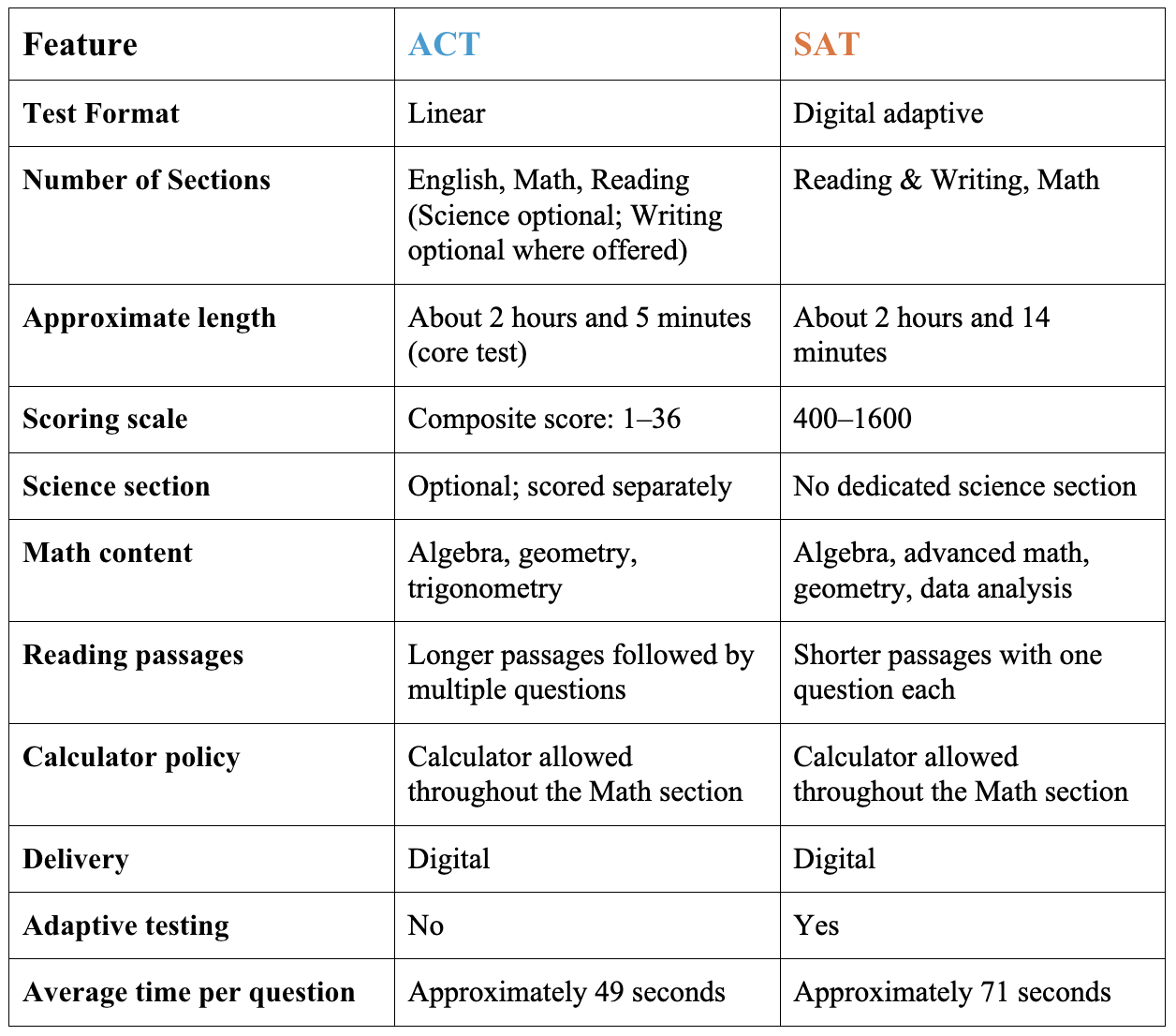
Key Differences Between the ACT and SAT
Test Format and Structure
One of the biggest differences is the SAT’s digital adaptive format. Students complete the first module of each section, and their performance determines the difficulty of the second module. This allows the exam to adjust to a student’s ability level while still producing a standardized score.
The ACT follows a traditional linear format, meaning every student receives the same sequence of questions regardless of performance. Some students appreciate the predictability of this structure, while others enjoy the personalized nature of the adaptive SAT.
Timing and Pace
The ACT is widely considered the faster-paced exam. Students typically have less time to answer each question, making speed and efficient decision-making especially important.
The SAT generally provides slightly more time per question, allowing students additional opportunities to think through multi-step problems. Students who prefer a less rushed testing experience often find the SAT more comfortable.
Math Content
Both exams assess algebra and geometry, but they differ slightly in emphasis. The SAT places greater focus on algebra, advanced math, and problem-solving with real-world applications. Many questions require students to apply multiple concepts before arriving at an answer. The ACT includes a broader range of topics, including more geometry and trigonometry.
While calculators are permitted throughout the math sections on both exams, the question styles differ, with the ACT often favoring straightforward calculations and the SAT emphasizing analytical reasoning.
Reading and English Sections
The reading portions of the two exams look quite different. The SAT features shorter passages paired with a single question, making it easier for students to concentrate on one idea at a time. The ACT includes longer reading passages followed by multiple questions, requiring students to quickly locate evidence and maintain focus across larger sections of text.
Both exams also test grammar, punctuation, sentence structure, and writing conventions. The SAT tends to emphasize vocabulary in context and rhetorical effectiveness, while the ACT English section focuses heavily on grammar and usage rules.
The ACT Science Section
The ACT Science section is now optional and is scored separately from the Composite ACT score. Students who choose to take it are tested on interpreting charts, graphs, data tables, and experimental results rather than memorizing scientific facts.
The SAT does not include a dedicated Science section, though it incorporates science-based passages and data interpretation throughout the exam.
Which Test Fits Your Learning Style?
Every student has unique strengths, making one exam a better fit than another.
The ACT may be a better choice if you:
- Read quickly and efficiently.
- Work well under time pressure.
- Prefer direct, straightforward questions.
- Are interested in the idea of taking an additional Science section that emphasizes interpreting charts, graphs, and experimental data.
The SAT may be a better choice if you:
- Enjoy analytical problem solving.
- Prefer slightly more time per question.
- Perform well on adaptive tests.
- Like multi-step reasoning challenges.
If you’re unsure which exam is the better fit, start by taking a diagnostic test. Comparing your performance on both exams can help identify the format that aligns best with your strengths, allowing you to focus your preparation where it will have the greatest impact.
How Colleges View ACT and SAT Scores
Admissions offices generally treat ACT and SAT scores equally. Colleges focus on the strength of your score rather than which exam you took.
Many schools also remain test-optional, allowing applicants to decide whether submitting scores strengthens their application. However, strong standardized test scores can still enhance admissions decisions and increase eligibility for scholarships.
Some colleges also offer superscoring, combining your highest section scores across multiple test dates. Because policies vary, students should always research the requirements of each college on their application list.
Choose the Right Test and Start Preparing Today
The ACT and SAT are both excellent pathways to college admission. While they differ in structure, pacing, and question style, colleges value them equally. The key to success is choosing the exam that best fits your strengths and preparing for it strategically.
If you’re unsure where to begin, start with a diagnostic assessment, build a personalized study plan, and seek guidance from experienced educators. Test Prep Score provides individualized ACT and SAT tutoring designed to help students identify the right exam, improve their scores, and achieve their college goals.
Ready to take the next step? Contact Test Prep Score today to schedule personalized ACT and SAT tutoring and start preparing with confidence.
Frequently Asked Questions
Frequently Asked Questions
Do colleges prefer the ACT or the SAT?
No. Nearly all U.S. colleges accept ACT and SAT scores equally and evaluate them using comparable admissions standards.
Is the ACT harder than the SAT?
Neither exam is universally harder. The ACT is generally faster-paced and includes a science section, while the SAT emphasizes adaptive testing and more analytical problem-solving. The better test depends on your individual strengths.
Should I take both the ACT and the SAT?
Most students benefit from taking diagnostic versions of both exams first. Once you identify which test better matches your skills, focusing on that exam is usually the most effective approach.
How much can tutoring improve my ACT or SAT score?
Score improvements vary by student, but personalized tutoring can help identify knowledge gaps, strengthen weak areas, improve pacing, and build confidence. Students who consistently follow a structured study plan often see meaningful gains over time.