
The ROI of an Economics Degree: Salaries, Career Options & Long-Term Value

Why Homework Feels Overwhelming for Neurodivergent Students (And How to Help)
August 3, 2026
Junior Year College Prep Checklist: A Month-by-Month Guide to SATs, College Visits & Applications
August 17, 2026
Is an Economics Degree Worth It?
Short answer: Yes. An Economics degree is generally considered worth it for students interested in analytical problem-solving, business strategy, finance, public policy or data-driven careers. Often earn high-paying salaries, Economics graduates can pursue careers in finance, consulting, data analytics, government, law, and graduate education.
Considering Economics?
A global job market flipping upside down, rapid AI advancements, and traditional employment feeling far-fetched: the anxious reality college students are faced with when entering the workforce. Choosing which degree to pursue becomes increasingly more important.
Studying economics can provide the necessary skills and advantages students are searching for.
Wondering if you should pursue an undergraduate degree in Economics? Or maybe you’ve already completed your degree and are interested in learning which paths are available to you? Either way, this blog outlines the return on investment (ROI) of an Economics degree and its different career journeys.
What Do You Learn as an Economics Major?
Studying Economics is a popular, intellectual choice for many undergraduates. Deeper than the misconceived reputation of budgeting and trading stocks, Economics also analyzes human behavior and decision-making driven by scarcity. Majoring in Economics in a 4-year accredited university typically begins with foundation theory courses, like Microeconomics and Macroeconomics, in addition to core quantitative requirements, like Calculus, Statistics, and Econometrics. Strengthening analytical thinking prepares students for success in higher-level, specialized electives.
Some Upper-Level Courses Include:
- Game Theory
- Labor Economics
- Behavioral Economics
- International Trade
- Money and Banking
Outside the classroom, many Economics majors also have access to research, internships, and senior capstone opportunities, working directly with esteemed professors and industry professionals.
Economics is a theory-heavy discipline, with interdisciplinary applications. Economics degrees are available in both Bachelor of Science (B.S.) and Bachelor of Arts (B.A.). A B.S. in Economics is data-driven and math heavy, creating a direct advantage as a master’s or PhD in Economics requires a high-level of mathematical understanding. Meanwhile, a B.A. in Economics is more flexible and a good option to pair with a broader, humanities career path like government or law.
How to Maximize the ROI of an Economics Degree
Many students ask the question: “Is Economics a good major?” Economics requires strong analytical and mathematical skills, especially for theoretical and abstract problems. This degree signals these valuable qualities in a student. It’s especially rewarding when specialized with academic concentrations or double majors in lucrative degrees.
Maximizing an Economics degree ensures students are increasing their visibility and skills in the ever-changing job market. Below are concentration and double major options based on career goals.
The Wall Street Track:
- Concentration in Financial Economics
- Ideal Double Major: Finance or Accounting
The Tech and Data Track:
- Concentration in Quantitative and Mathematic Economics
- Ideal Double Major: Mathematics or Statistics, Computer Science or Data Science
The Government/Policy Track:
- Concentration in Policy & Public Sector Economics
- Concentration in International Economics
- Ideal Double Major: Political Science
The Consumer Psychology Track:
- Concentration in Behavioral Economics
- Ideal Double Major: Psychology
What Can You Do with an Economics Degree?
Economics is an exceptionally versatile and flexible degree, training data-driven, abstract problem-solving that can be easily applied across disciplines.
Traditional Corporate Route
Economists are needed in industries like Finance, Tech, Management, and Government. Economic consultation provides businesses and institutions with critical data analysis and strategic forecasting to optimize operations and reduce risk. Research relating to monetary and fiscal policy is crucial to elevating the country’s standard of living. In other words, economists play an integral role in our corporate and consumer system.
Graduate School Route
While many economic-adjacent roles can be acquired with a B.S. or B.A., most Economist roles require a master’s or PhD in Economics. Advancing to the graduate-level economic curriculum is a successful move for students with an interest in becoming Economists. Economics is also a popular undergraduate degree for those interested in pursuing a master’s in business administration (MBA).
Academia, as opposed to industry-related positions, presents the opportunity to complete a PhD (Doctor of Philosophy) degree in Economics. Conducting an intense, 5-to-7-year research program and dissertation in a relating sub-field of economics provides a direct path to securing university-level professor positions and other high-paying economic industry jobs. These include policy and public sector economists in U.S. Federal Government, Federal Reserve System, and International Monetary Fund, or private sector economists in banks and consulting firms.
Law School Route
Students interested in Law School should consider completing an Economics degree in their undergrad. The American Economic Association emphasizes Economics majors score relatively high compared to other degrees on the Law School Admission Test (LSAT). Having an economic background and analytic foundation prepares students for the understanding and skills needed to succeed in law.
Alternative Industries
Beyond the traditional industries, Economic degrees can be applied to atypical industries, such as Urban Planning, Environment & Agriculture, Healthcare, and non-profits. The quantitative and qualitative forecasting acquired from studying Economics is highly transferable, specifically to sectors devising sustainable and predictive strategies.
Top 10 Highest-Paying Jobs for Economics Majors
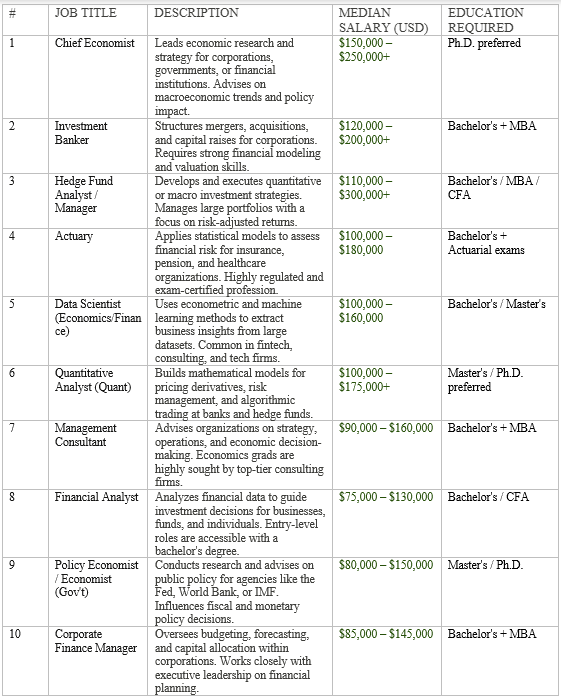
Additional careers include Market Research Analyst, Credit & Risk Analyst, Supply Chain Analyst, and Personal Financial Advisor.
Will AI Replace Economists: An Economist’s Outlook
Although new, entry-level job opportunities are increasing slower than previous years, this shift is largely accounted for by the introduction of Generative A.I. for automating their tasks. Economists, however, understand the “why” behind market behaviors and results and have a rigorous ability to predict and communicate these changes. Economists have a new opportunity to evaluate and address how A.I. and technology advancements are increasing in the workplace. Giving policymakers important information regarding inequality in the job market, many economists advise regulating A.I. as a productive tool for augmentation and not automation. Read more about this topic in the Harvard Business Review.
Test Prep Score Provides Career and College Counseling
An Economics degree is a stable and strong choice, providing many options when entering the job market. To learn more about Economics degrees, careers, and what the right path for you is, check out Test Prep Score and their personalized college and career counseling and tutors.
If Economics doesn’t feel like the right fit, don’t worry! Explore Test Prep Score’s blogs about other high-demand degrees and career paths, including Political Science and Computer Science, for a guide to navigating the new job market.
7 FAQs: Economics Degree, Careers, and Salaries
1) Is Economics a hard major?
Economics is a relatively difficult major for its rigor in quantitative and conceptual understanding. However, it is rewarding. To prepare correctly, ensure you have considered the major requirements for your college’s program, chosen the best path (B.A. or B.S.) for you, and continue exercising your mathematical and analyzation skills.
2) Is Economics better than Business?
No degree is inherently better than the other; both are versatile. It is important to consider the different focus of studies and career paths that fit you when choosing between an Economics and Business major. Refer to this NYU blog to learn more about the key differences in Economics and Business majors.
3) Can you work in Finance with an Economics degree?
Yes, economics is a common and valuable degree for someone who wants to work in the Finance industry. The skills strengthened when studying Economics are increasingly sought out in business, and this degree demonstrates an individual’s flexible, strategy-oriented thinking.
4) What GPA do you need for Economics graduate school?
Economic graduate programs generally require a GPA of minimum 3.0 and higher to qualify for admission. Most competitive, PhD programs look for candidates with a 3.75 or higher GPA.
5) Is Economics a STEM discipline?
Economics is traditionally a social science, but colleges have been increasingly designating it as a STEM degree for its focus on math and data analytics.
6) Best high-paying, entry-level jobs for an Economics degree?
Most economics majors start their career in the Finance industry as a financial, credit, or investment banking analyst, Consulting industry as a management or economic consultant, and Data Science industry as a market research or data analyst.
7) Average salary for Economics majors?
The salary range for Economics majors is between $100,000-115,000 for mid-career jobs. Explore more careers and salaries at the U.S. Bureau of Labor Statistics Occupational Outlook Handbook.

